


Ministry of the Interior and Academia Sinica Adopt Feng Chia Student Project to Develop 3D Public Service for Building Photovoltaic Queries
2026/07/20
FengChia Featured


Hsieh Chen-yuan, Lin Tzu-ting, and Yeh Yu-chen, students from the Department of Urban Planning and Spatial Information at Feng Chia University, were awarded first place in the Undergraduate Category of the 8th National Spatial Data GIS Competition on July 1 for their research on urban solar photovoltaic potential maps. This student project not only won the top prize,
but also gained significant attention from the National Land Surveying and Mapping Center (NLSC) of the Ministry of the Interior and
Academia Sinica. Through industry-government-academic collaboration,
the award-winning work has been expanded and transformed into the '3D Building Roof Solar Photovoltaic Potential Query Service,' available for free to the public. The system currently supports queries within Taichung City and is expected to expand to the six special municipalities by the end of August 2026.
With the promotion of the 'Standards for Installing Solar Photovoltaic Power Generation Equipment on Buildings,' new constructions, additions, or alterations of buildings with a floor area of 1,000 square meters or more should, in principle, install 1 kilowatt (kW) of solar photovoltaic equipment for every 20 square meters.
To assist the public, the construction industry, and the photovoltaic industry in understanding the installation conditions of individual buildings, the NLSC invited the original winning team to expand their research results. The system development and application transformation were jointly carried out by the Center for Geographic Information Science at the Research Center for Humanities and Social Sciences (RCHSS) of Academia Sinica, the Department of Urban Planning and Spatial Information at Feng Chia University, and PilotGaea Software Co., Ltd.
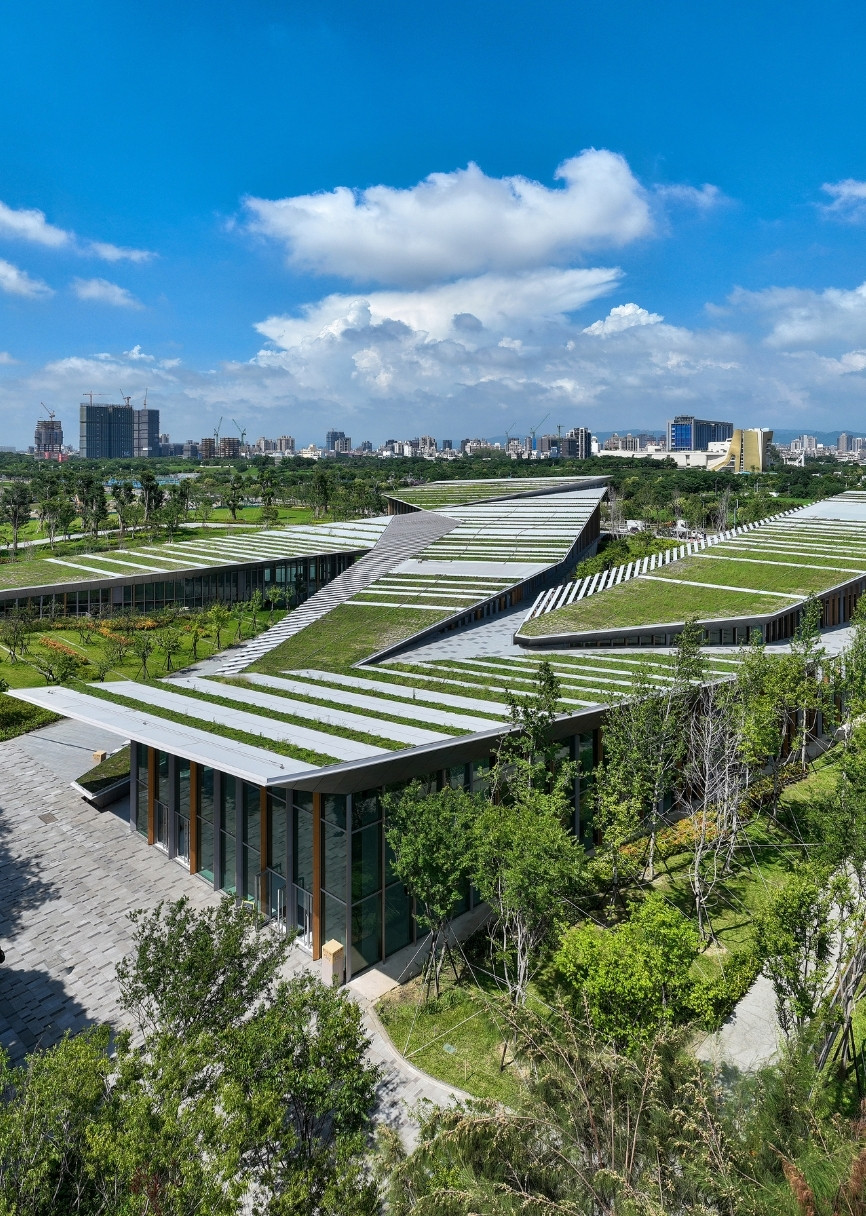
Kengo Kuma's 'Anti-object Architecture' Gong Shan Building at Feng Chia University Wins Taichung Urban Space Design Award
The '3D Building Roof Solar Photovoltaic Potential Query Service' integrates the Ministry of the Interior's multi-dimensional spatial data, terrain fluctuations, surrounding building shadow simulations, and land use status data. It also incorporates practical parameters such as solar panel conversion efficiency, Performance Ratio (PR), roof availability coefficients, and announced Feed-in Tariffs (FiT) to estimate the effective installation area, projected capacity, power generation potential, and financial returns for each building.
- Liao Hsuan-ming, an Associate Research Engineer at Academia Sinica who facilitated this collaboration, noted that
- when users access Academia Sinica's '3D Spatio-Temporal Information Integration Platform,'
- they can search for the 'Building Photovoltaic Potential' function and enter a street address,
- Liao Hsuan-ming, an Associate Research Engineer at Academia Sinica who facilitated this collaboration, noted that when users access Academia Sinica's '3D Spatio-Temporal Information Integration Platform' and search for the 'Building Photovoltaic Potential' function by entering a street address, the system can automatically locate the building.
- Through the 3D building models, the public can directly view the power generation area and estimated returns. They can also enable the 'Overlay' function to intuitively understand the power generation potential of different sections of the building roof.
The '3D Building Roof Solar Photovoltaic Potential Query Service' integrates the Ministry of the Interior's multi-dimensional spatial data,
terrain fluctuations, surrounding building shadow simulations, and land use status data,
and incorporates solar panel conversion efficiency, Performance Ratio (PR),
roof availability coefficients, and practical parameters such as announced Feed-in Tariffs to
the effective installation area, projected capacity, power generation potential, and financial returns of buildings.
¢ ♦